Compost offers nice organic dirt to add to gardens – but also reduces landfill and greenhouse gases produced by landfill.
Landfills provide an anaerobic (no oxygen) environment, whereas compost bins are aerobic (with oxygen) (Mussa et al., 2025). The difference is that with oxygen microbes can decompose compost, thereby creating mainly carbon dioxide, whereas landfills produce the much more of the powerful greenhouse gas: methane. Without food waste, landfills would create much fewer greenhouse gases.
Another advantage of compost is its output: organic fertilizer that sequesters carbon and reduces the amount of chemical or mineral fertilizers used. This reduces greenhouse gases generated in the creation of artificial fertilizers and reduces water pollution during leaching (Fan et al., 2018).
My Experience
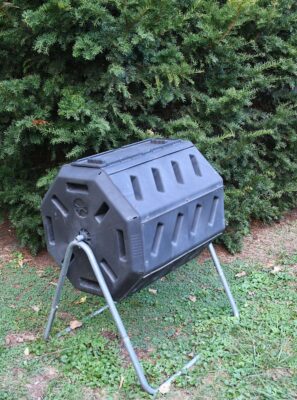
I have a neighbor who built his beautiful and productive vegetable garden one compost pile at a time. When the compost was done, he planted flowers or vegetables there and moved his compost pile somewhere else. I have chosen to use a compost bin, as shown in photo, which makes it easy for me to load my scraps in and rotate the bin 3 times to mix it well. Then, at least twice a year I use the compost as fertilizer around my garden. Compost is useful as fertilizer early spring and also at the time of highest productivity in your garden according to a vegetable gardening class I took.
Your Choices
| Action Choices and Links |
| Build Your Own Compost |
| Use a Compost Service |
| The Science: How Composting Works |
| Return to: Sustainable Gardening |
Build Your Own Compost
An advantage of building your own compost is that after setup, it is free: dump your food wastes to your compost bin and reap organic soil rewards.
Compost should be made of near-equal parts of food scraps and bulking agents. Food scraps include vegetable and fruit peels and waste and egg shells. However, it is better to not include plant seeds. Meat scraps are not recommended in a compost because they attracts carnivores, which can threaten small children and animal companions. Food scraps decompose most quickly when thin (1-3 millimeters) rather than thicker pieces (5-10 millimeters or to 1/2 inch) (Mussa et al., 2025).
For bulking agents, dried leaves, grass cuttings or tree pruning remains well, as does paper, coffee grounds or tea waste, or husks or straw from rice, corn, grains, beans, wheat, etc (Mussa et al., 2025). Alternatively, if you have a vegetarian animal like a rabbit, guinea pig, or hamsters, you can use their paper litter and feces as a bulking agent. Finally, wood chips, sawdust and soft wood can also work well, as long as paint or creosote, with their toxic chemicals or heavy metals, are avoided (Vázquez & Soto, 2017). If your compost is coming out wet then you need more bulking agent.
It is recommend to turn your compost once a week (Fan et al., 2018). Compost takes at least a month to convert to organic soil, and should go through a process where it gets hot enough to kill pathogens (Mussa et al., 2025). The compost may smell the first week, but this subsides soon after.
Use a Compost Service
A compost service gives you a container to throw your food wastes into. They do charge a monthly fee but offer compost dirt as a benefit. Often, they allow meat scraps in addition to vegetable, fruit and egg scraps, due to their controlled environments. They pick up your food wastes according to a weekly, biweekly or monthly schedule, visiting businesses more frequently than homes. In Chicago, the starting rate for compost pickup is $20/month. You can search online for a compost service near you.
A local composter, Urban Canopy, indicates in its brochures that for every 100 pounds of food waste that it composts, about 260 pounds of greenhouse gas emissions are prevented.
The Science: How Composting Works
Food waste is high in Nitrogen whereas bulk agents are high in Carbon. Bacteria and microbes that decompose waste prefer a Carbon-to-Nitrogen (C:N) ratio of 25:1. A ratio of 50:50 food waste to bulk (dry leaves and rice bran) offers a C:N ratio of about 25:1 (Fan et al. 2018). In contrast, a ratio of 70:30 food waste to bulk provides a C:N ratio of 15-18 (Mussa et al., 2025). Both ratios are doable, but the higher C:N ratio is known to generate more heat to kill pathogens. Bulk agents not only balance C:N ratios and raise heat but also increase air spaces for aeration and reduce moisture (Mussa et al., 2025).
Compostable waste in landfills include food waste 21-25%, paper or paperboard 15%, yard waste and wood trimmings 16% of waste (EPA, 2020). This totals around 50% of waste entering landfills that could be ‘recycled’ into organic matter.
If the decomposition process is not turning food waste into dirt within one month, it is possible to add commercial “compost accelerators” (Fan et al., 2018). Compost accelerators reputedly also reduce any smell the first week, but I can attest that when they contain manure, the compost will smell even stronger!
References
EPA (2020) Composting Food Waste: Keeping a Good Thing Going, October 2020, Environmental Protection Agency. From: https://www.epa.gov/snep/composting-food-waste-keeping-good-thing-going.
Fan, Y. van, Lee, C. T., Klemeš, J. J., Chua, L. S., Sarmidi, M. R., & Leow, C. W. (2018). Evaluation of Effective Microorganisms on home scale organic waste composting. Journal of Environmental Management, 216, 41–48. https://doi.org/10.1016/j.jenvman.2017.04.019.
Mussa, S., Farhan, M., Ahmad, S., Zahra, K., Kanwal, A., Khan, Q. F., Afzaal, M., Wahid, A., Sarker, P. K., El-Sheikh, M. A., & Ali, S. (2025). Exploring the utility of different bulking agents for speeding up the composting process of household kitchen waste. Scientific Reports, 15(1), 2488. https://doi.org/10.1038/s41598-025-85433-0
Vázquez, M. A., & Soto, M. (2017). The efficiency of home composting programmes and compost quality. Waste Management, 64, 39–50. https://doi.org/10.1016/j.wasman.2017.03.022.