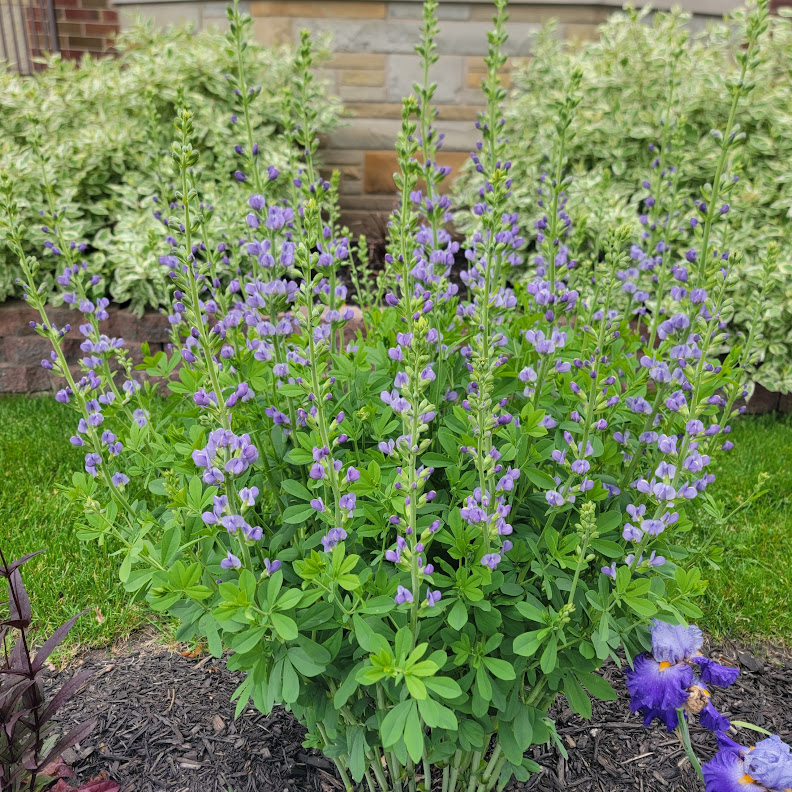
Why Native Plants? Gardening with native plants is eco-friendly because it supports local wildlife, and create sustainable, thriving gardens tailored to an environment, by:
- Enhancing local ecosystems by attracting native pollinators (butterflies, bees) and wildlife (birds)
- Reducing water usage through drought-resistant native species
- Promoting soil health and natural pest control without chemicals
- Creating beautiful, low-maintenance landscapes that flourish naturally
- Costing less than some other options suggested by this website!
Native Plants Help Pollinators
Rates of insects are declining in both America and Europe. This is problematic because insects pollinate most fruits and many vegetables. In addition, many birds, including robins, depend on insects for their diet. It is estimated that most at risk for extinction include bees (35% risk), butterflies (20% risk), macro-moths (16%), and flower flies (15%). Even worse at risk are bats, which are 100% at risk (Cornelisse et al., 2025).
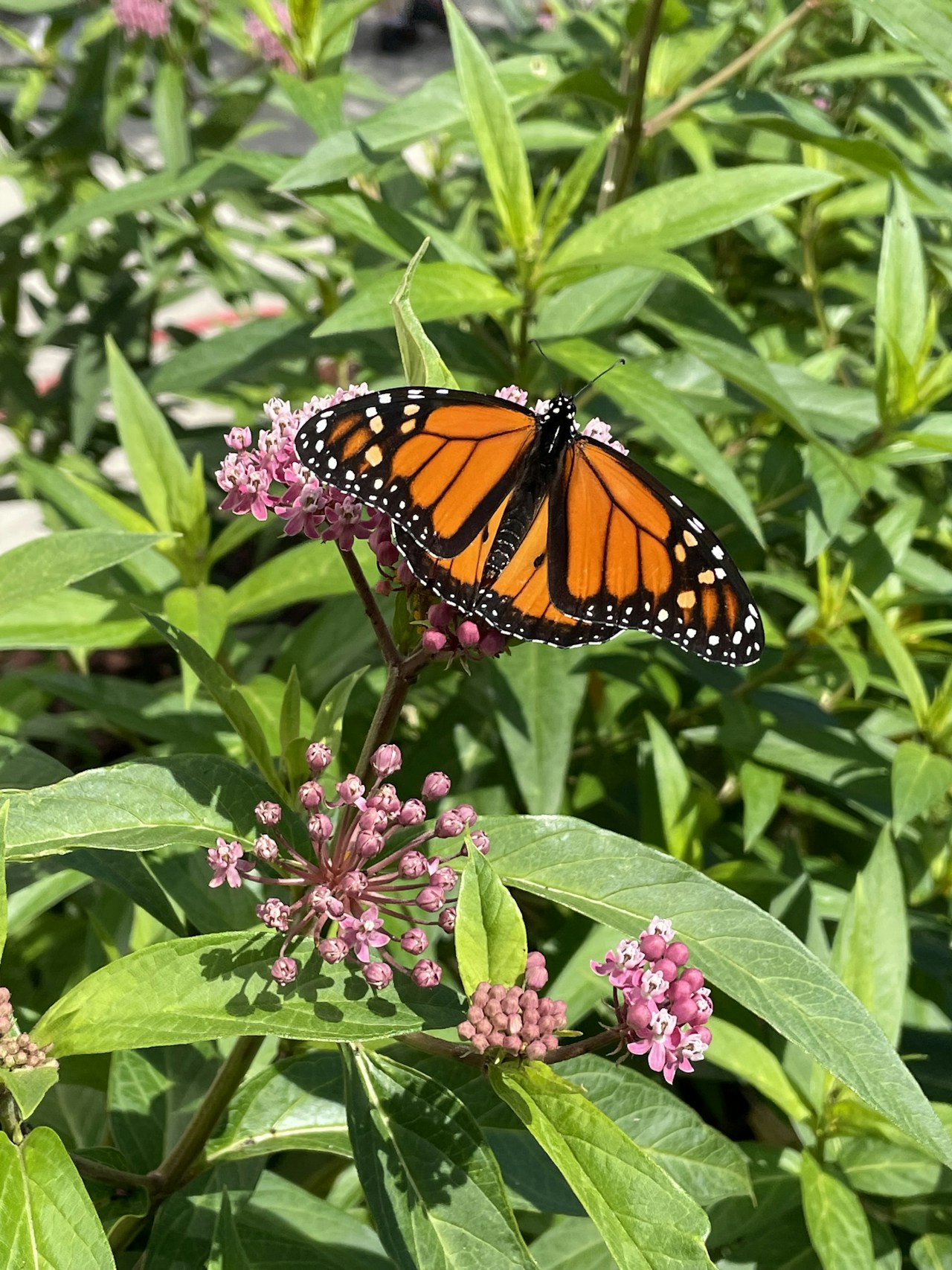
Pollinators often prefer specific plants for reproduction and diet. For example in America, Monarch butterflies (shown in bottom photo) depend on milkweed. Decreases in insect populations are observed particularly in cities, in part due to impervious (or non-natural) environments (Chandler, 2003), pesticides, and full-spectrum LED lights (Seymoure et al., 2024).
Our Experience
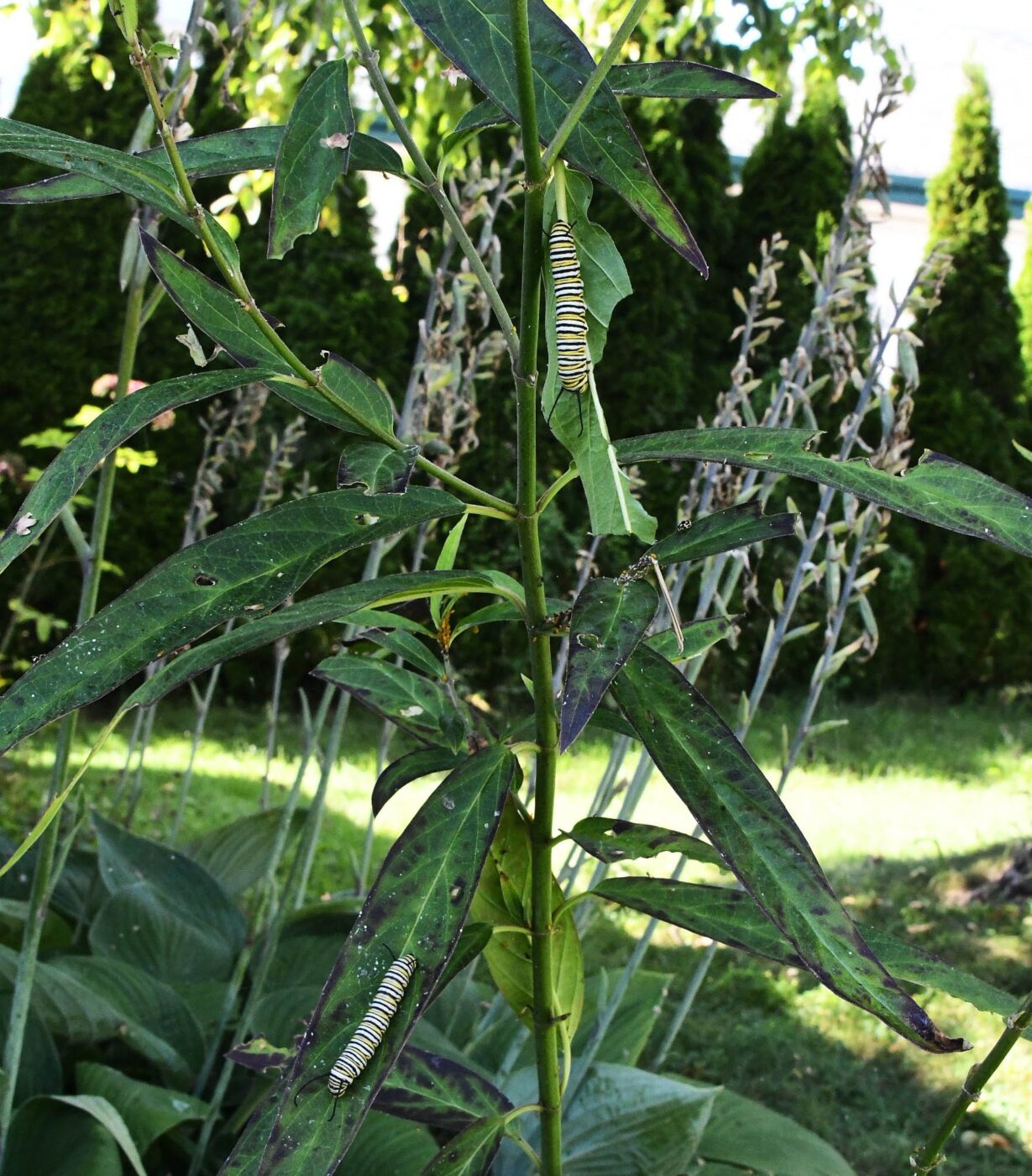
I was so thrilled the first year that I planted milkweed and saw 2 Monarch caterpillars (seen left) and a Monarch butterfly! Native gardens take a year or two to start to flourish, so you must be patient while the plants establish good roots. I have found it helpful to have green-thumb friends, or pay a gardener, to advise on plant health.
You may ask: isn’t a grass lawn a native perennial? Yes it is. However, mowed lawns offer very little carbon sequestration and do not provide good pollinator habitat or wildlife food, since it offers no flowers, seeds or berries.
Additionally, native plants are attractive and easy to care for: mainly weed after the first year.
Your Choices: How You Can Help
| Action Choices and Links: Gardening with Native Plants |
| Plan and Buy Plants Native to Your Area |
| Find Proper Location and Water the First Year |
| Parent Link: Sustainable Gardening |
Plan and Buy Plants Native to Your Area
Native to my Wisconsin garden may not be native (and survivable) in your garden. Wild Ones is an excellent organization with many local chapters that sponsors educational talks and native plant sales selling plants that will survive near you. Their website is: https://wildones.org/. When buying native plants, also consider whether they will be planted in sunny or shady areas. Forest natives are good for shady areas.
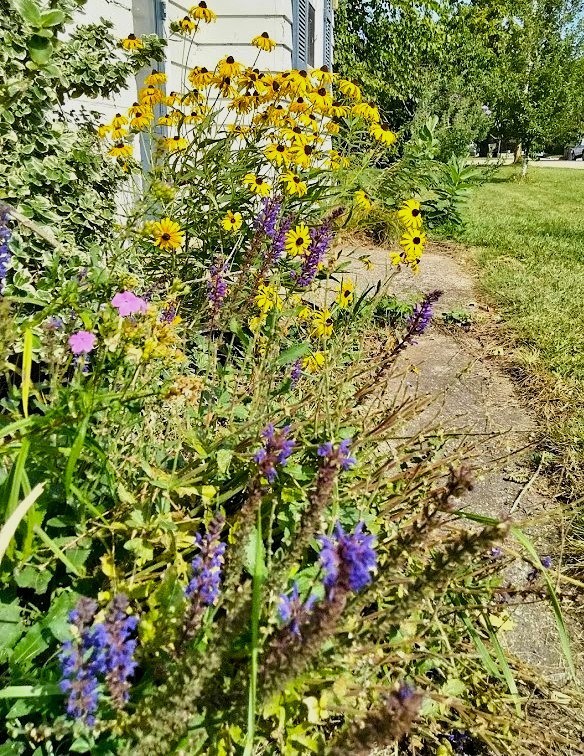
One way to plan a native garden is to 1) consider the colors you want and wildlife you would like to attract; 2) layer your plants with shorter plants in front of larger plants; and 3) consider which plants will be in bloom at once. It is good to have some plants in bloom in all months, to provide food for pollinators. For example, the following table provides plant name, color, height, and shows bloom times. The Chicago Bird Alliance (2026) also recommend designing plants in clumps of odd numbers, such as 3s, 5s, 7s; using fewer different species and larger quantities of each; and using a varied mix of flowers and grasses.
| April | May | June | July | August | September | October |
| Prairie | Violet | 6 inches | ||||
| Prairie Loosestrife | (Yellow) 1-2 feet | |||||
| Lanceleaf | Coreopsis | (Yellow, Orange) | 2 feet | |||
| Smooth | Blue Aster | 4 feet | ||||
| Green | Milkweed | (White) 4 feet | ||||
| Black-Eyed | Susan | (Yellow) 5 feet |
Find Proper Location and Water the First Year
Natives are perennials and will first establish a root system before putting energy into developing flowers. Therefore, do not expect a good flower display the first year. Be patient! To ensure success, be sure to water regularly for the first year until roots are well established.
References
CHANDLER C. MORSE, A. D. H. C. C. (2003). IMPERVIOUS SURFACE AREA AS A PREDICTOR OF THE EFFECTS OF URBANIZATION ON STREAM INSECT COMMUNITIES IN MAINE, U.S.A. Environmental Monitoring and Assessment 89: 95–127, 2003., 89, 95–127.
Chicago Bird Alliance (2026). Native Plant Sale. https://chicagobirdalliance.org/native-plant-sale-1.
Cornelisse, T., Inouye, D. W., Irwin, R. E., Jepsen, S., Mawdsley, J. R., Ormes, M., Daniels, J., Debinski, D. M., Griswold, T., Klymko, J., Orr, M. C., Richardson, L., Sears, N., Schweitzer, D., & Young, B. E. (2025). Elevated extinction risk in over one-fifth of native North American pollinators. Proceedings of the National Academy of Sciences, 122(14). https://doi.org/10.1073/pnas.2418742122
Seymoure, B., Parrish, T., Egan, K., Furr, M., Irwin, D., Brown, C., Crump, M., White, J., Crooks, K., & Angeloni, L. (2024). Better red than dead: Plasticine moths are attacked less under HPS streetlights than LEDs. Basic and Applied Ecology, 74, 66–73. https://doi.org/10.1016/j.baae.2023.11.008
s