
See how your home electricity compares with other homes in your state, here. Ways to save electricity include new energy-efficient appliances, since newer versions of these appliances can save more than 2-3 tons of greenhouse gases per year (depending on appliance).
Appliances that use the most electricity include furnaces (heating) and air conditioning (cooling), depending on where you live. However, water heaters also are high in energy use. My Experience shows the gas and electrical savings I encountered with an energy efficient furnace.
If you can’t afford new appliances now, commit to energy efficient appliances when you next purchase one. Then feel good about using your appliance for a long time, which does reduce the greenhouse gases of new manufacturing (not considered in my Table 2 below). In the mean time, work on home energy efficiency, since the cost of improvements are considerably less than new electrical appliances and the savings can be considerable.
Your Choices
| Action Choices and Links: Save Electricity | Cost | Notes |
| Compare Your Electrical Usage | 0 | Shows the average monthly residential electricity bill, kilowatt-hours and annual greenhouse gases for each U.S. state. |
| Address Your Entire Electricity Bill: Solar or Clean Subscription | Solar: $$,$$$ Subscription: $ to $$ | |
| New Appliances are Much More Energy Efficient | Purchase cost: $$$ to $$$$ | There are additional pages (links) for HVAC, water heating and cooking |
| My Experience | Considerable Savings | I upgraded my furnace, but my recommendation is a heat pump |
| Ways to Save Energy | $ to $$$$ | Energy efficiency in homes can save in cold and hot climates |
Compare Your Electrical Usage
See how your home compares with others in your state and region, including average monthly costs, kilowatt hours, and greenhouse gases here.
Address Your Entire Electricity Bill: Solar or Clean Subscription
A quicker way to cut greenhouse gas emissions from electricity is to make all your electricity clean. This can be achieved by installing solar panels on your roof or purchasing clean energy from your provider. When choosing a clean energy option, you can offset half, most, or all of your greenhouse gases depending on your plan or subscription. Check with your provider about how your rates may change annually. Fuel cost increases for avoiding fossil fuels may be small or significant, depending on the provider. Clean energy should come from renewable sources such as solar, wind, or geothermal.
New Appliances are Much More Energy Efficient
Engineers have made remarkable progress in lowering electricity consumption over the past decades. Many modern appliances use just a tenth (1/10) of the electricity compared to older models. Upgrading to new appliances may save you a significant – or sometimes modest – amount of money and reduce your greenhouse gas footprint, depending on which appliance you replace. The table below highlights the approximate electrical loads of older versus newer appliances, demonstrating that you can invest in a greener lifestyle.
If you decide to invest in energy-efficient appliances, this table compares the energy consumption of typical home appliances (second column) with that of new, state-of-the-art models (third column). The far-right column shows potential savings in kilowatt hours (kWh) and equivalent greenhouse gas reductions, listed in metric tons (tonnes). The ranges in column three reflect the lowest and highest greenhouse gas values.
| Action Choices and Links | % Avg. Energy Use per Home Traditional kWh with Older Devices | State-of-the-Art: EnergyStar’s ‘Most Efficient’ Appliances Source: U.S. www.energystar.gov | Improvement in GHG with More Efficient Device |
| Heating and air conditioning | 46 to 47% total 10,200 to 23,400 kWh/year In northern states: 29% heat 17% cooling | Heat pumps can replace furnace and central air conditioning up to 300% efficiency. EnergyStar Furnaces rate to 98 to 99% efficient for natural gas, propane gas. | |
| Water Heating | 14 to 21% (U.S. govt: 20%) 4860 to 5400 kWh/year | Estimated to use 70% less energy and to save $550/year for family of 4. Heat pump water heater averages 1213 kWh per year | 4668 to 6912 lbs GHG OR 2117 to 3135 kg GHG = 2 to 3 tons GHG |
| Lighting | 8-12% Lumens Incand Halogen 375 25 20 800 60 45 1600 100 90 | CFL LED 4 13-15 6-8 23-28 16-20 | 1 100W Incandescent = 72 kWh/year. For full electricity impact, multiply by number of light bulbs and hours. Incandescents last 1,200 hours. CFLs last 8000 hours each. LEDs last 50,000 hours each. LEDs are 25% more efficient than discontinued fluorescents; replace with T8 (1 inch) or T12 (1.5 inch) LED according to fluorescent diameter. |
| Refrigeration | 4-5% 1200 to 1944 kWh/year | For Bottom Freezer: 12.8 ft3: 295 to 386 kWh/yr 16.1 ft3: 355 to 438 kWh/yr 28 ft3: 595 kWh/yr Top Freezer: 17.5 ft3: 333 to 448 kWh/yr 20 to 21 ft3: 371 to 477 kWh/yr Side-by-Side: one product rated “Most Efficient” 27.4 ft3: 546 kWh/yr | Assumes 300 to 500 kWh/yr: 1152 to 1848 lbs GHG or 523 to 838 kg GHG = 0.5 to 0.8 ton GHG |
| Cooking | 3 to 4% 680 to 1440* kWh/year * assumes 1 hr/day each: oven, stove | Induction: 187-190, 195 kWh/yr Radiant: 195 kWh/yr Coil: 195 kWh/yr | Assumes 190 to 195 kWh/yr: 627 to 1594 lbs GHG OR 284 to 723 kg GHG =0.3 to 0.7 ton GHG |
| Electronics – Entertainment | 3% 660 kWh/year (assumes 5h TV/day and 6h gaming/week) | ||
| Clothes Washing/ Drying | 3 to 13% Washer: 900 kWh Dryer 845 kWh | Front Load Washer: 4.5 to 5 ft3: 74 to 120 kWh/yr; 452 to 4900 gallons/yr No Top Load Washers rated Most Efficient 5 to 5.7 ft3: 110 to 150 kWh/yr; 4700-6087 gallons/yr Dryer: 4 ft3: 125-154 kWh/yr; 4.5 ft3: 217-245 kWh/yr; 7.8 ft3: 266-460 kWh/yr; | Washer assumes 75-150 kWh/yr: 960-1056 lbs GHG OR 425-479 kg GHG Dryer assumes 125 to 460 kWh/yr: 493 to 922 lbs GHG OR 224 or 418 kg GHG =.65 to .9 ton GHG (for washer & dryer) |
| Room Air Conditioner | 800 kWh Varies by size, age. | 12,000 Btu: 592 to 600 kWh 10,000 Btu: 470 to 500 kWh 9000 Btu: 415 to 422 kWh 8000 Btu: 375 to 414 kWh | |
| Dishwasher | 2% 600 kWh/year | Max Place Settings = 12 225 kWh/yr; 2.36 gallons/cycle Max Place Settings = 16 210 to 225 kWh/yr; 3.2 gallons/cycle | Assumes 225 kWh: 557 lbs GHG OR 253 kg GHG =1/4 ton GHG |
| Computers | 1% | Battery-operated laptops are more efficient than desk-tops; both are low in power. Gaming equipment has higher electricity requirements. |
Notes On Interpreting Above Table
Units and Abbreviations: lbs is an abbreviation for pounds, Kg is an abbreviation for kilograms, both are units of measurement of weight.
- kWh = Kilowatt hour, a unit of measurement used by electricity providers to measure electrical use.
- Ton refers to a metric ton, or tonne.
- GHG = Greenhouse Gas.
Sources for Column 2 are shown in the References.
How to calculate your existing device’s actual kilowatt hours (kWh)
To find your current level of kWh, it may be:
- estimated on an attached EnergyStar sticker; or
- measured with a kill-a-watt (for lower voltage/amp appliances); or
- listed (embedded) on the appliance.
To calculate greenhouse gas savings = (Column 3 – Column 2) * 1.28 lbs CO2/kWh => lbs CO2.
My Experience
My peak energy improvement was upgrading my furnace. I expected to see lower gas bills, but I was pleasantly surprised by the additional electricity savings as well. The chart below illustrates my electricity usage (vertical axis) against average temperatures (horizontal axis) after installing a 95% efficient furnace in 2011. Today, we have the option to eliminate gas bills entirely—along with the risks of methane leaks and their associated health hazards—by switching to a heat pump, which is much more efficient than even a 95% efficient furnace. Your Heating, Ventilation, and Air Conditioning (HVAC) system represents your largest energy expense and offers the greatest potential for savings. Therefore, upgrading to efficient heating or cooling appliances can significantly reduce your costs over time.
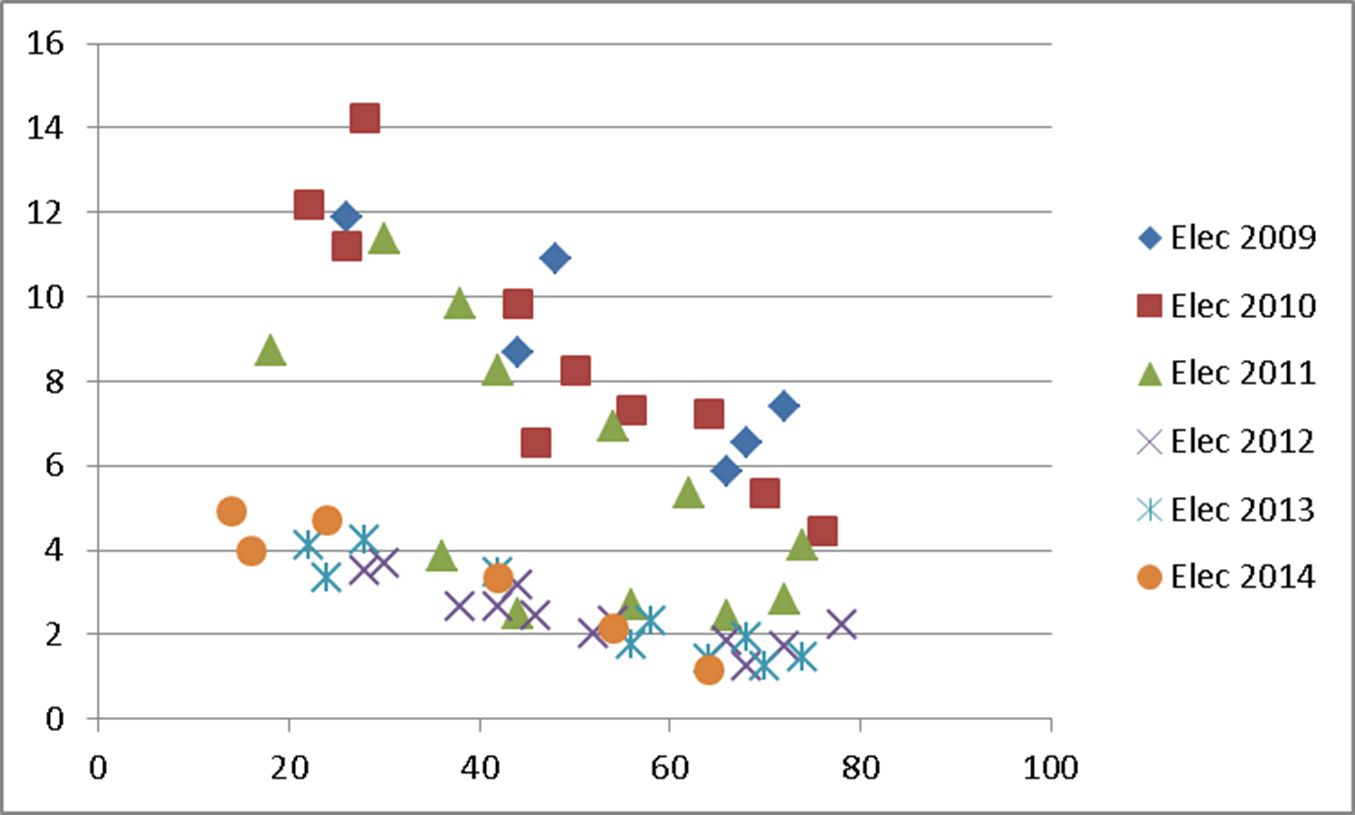
We use 100% clean energy through my electricity provider in Wisconsin and have installed solar panels on my husband’s Chicago home. This effectively reduces the greenhouse gas emissions from electricity for both homes to near zero or even less.
References
References for this section and links includes:
- Harley, Bruce (2012) Insulate and Weatherize for Energy Efficiency at Home. The Taunton Press, Newtown CT.
- Amann, Jennifer Thorne, Wilson, Alex, and Ackerly, Katie (2012) Consumer Guide to Home Energy Savings, 10th edition. New Society Publishers, Gabriola Island, BC Canada.
- Presentation: How to Save the Planet and Save Money Too, 27 January, 2025.
Sources for Column 2 of Table:
- Energy Efficient Homes for Dummies
- GreenLogic Energy: https://greenlogic.com/blog/the-top-5-biggest-users-of-electricity-in-your-home
- Wisconsin Energy: https://www.we-energies.com/savings/tips
- https://www.voltlighting.com/learn/lumens-to-watts-conversion-led-bulb
- Comparison Chart: LED Lights vs. Incandescent Light Bulbs vs. CFLs, https://www.usailighting.com