
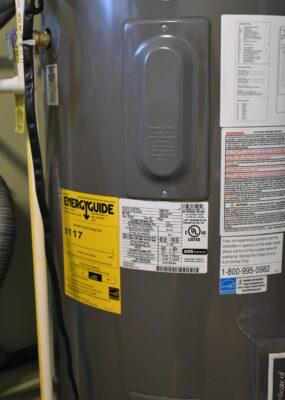
After your furnace or air conditioning system (depending on where you live), upgrading a hot-water heater is the most energy-saving action you can take in your home. Switching to an energy efficient device can help you save money and do your part for the environment.
Alternatively, consider turning your hot-water heater off during part of the day. Theoretically if you leave it on for 6 hours a day and off for 18 hours, you pay 1/4 the electricity bill. It is possible if there is an on-off switch dedicated to the hot-water heater. This is a common practice in India, according to an Indian friend.
My Experience: Legionnaires Disease
Since my husband and I had two homes in two different states due to our jobs, I went back and forth from my home, always turning the hot water off while I was away. I found I was getting headaches at my home. At first I tried bottled water, and my headaches went away. Then I purchased a water distiller to save money, avoid plastic in my drinking water, and eliminate my sky-rocketing garbage of water bottles.
However, a couple years later, my 20-year old water heater did not heat water to its previous levels, and baths became warm but not hot. Again, I started drinking bottled water, but still got daily headaches. I asked the city to test my water and they visited for free. They tested only cold water for bacteria and found none. The tester told me he completely empties his hot water tank once a year, to clean it out and eliminate gunk. I did, but also started reading about bacteria in hot water heaters, also potentially pools.
Legionnaires’ disease can be caused by a variety of bacteria. The optimal temperature range for legionnaire’s bacteria is 68-113°F (20-45°C). When you turn on a faucet or shower head, you are causing water droplets to enter the air. Symptoms of Legionnaires are typically respiratory illness, potentially including flu, fever, chills and intense headaches. Neurological symptoms may include confusion, dizziness, loss of balance, and gastrointestinal problems may include nausea, vomiting, diarrhea. For more information, see: https://knowwhatis.com/health/legionnaires-disease-symptoms-causes-risk-factors. At that point, I decided that year’s environmental project would be a new Heat Pump (Hybrid) Water Heater.
Fortunately, this solved my headaches. However, the electricity for the water heater was not up to code. So I had additional considerable expenses in upgrading to the 240 volts with 30 amp requirement for the new water heater.
Your Choices
| Action Choices and Links: Upgrading a Hot-Water Heater |
| Upgrading a Hot-Water Heater |
| Operate Water Heater at 120° F |
| Parent Link: Ways to Save Energy |
| Parent Link: Ways to Save Electricity |
Upgrading a Hot-Water Heater
Water heaters have improved in their efficiency considerably; older water heaters may cost as much as or more to operate than recent furnaces or air conditioners. Three common water heaters include storage tank, on demand, and the newest, heat pump. An Energy Factor (EF) rates their efficiency and applies to all three types. When I purchased a heat pump water heater (in 2026) my sales person quoted annual operational costs for a 40 gallon heater as: heat pump (hybrid) $115.00 per year; electric water heater $475.00 per year; gas water heater $275.00 per year. Energy star estimates savings of $550 per year for a family of four for a heat pump water heater.
Heat Pump “Hybrid” Water Heaters
Hybrid Electric Heat Pumps water heaters can operate in normal electric or heat pump mode. Energy Star (2026) claims that home water heater use more energy than your refrigerator, clothes washer, dishwasher, and dryer combined! Best-in-class devices offer Uniform Energy Factors of 4.0-4.5, whereas the best gas heaters (below) range nearly to 1.0. Heat pump water heaters are especially popular in warm weather climates, where they may operate indoors or outdoors.
Operational Differences: In heat pump mode, they ventilate out air that is 10-15 degrees cooler than air around them. They also make more noise than standard water heaters, similar to a low-volume air conditioner. While the cooler fan action may be desirable in warm climates, in cooler climates ‘electric’ mode can return the water heater to silent, no venting.
Access to Air: Heat pumps need sufficient warm air around them and exhausted air is cool and dry (excellent for basements) (Harley, 2012)(Amann et al. 2012). The room should be 10 feet by 10 feet large to provide sufficient air. If it’s in a smaller room, it would require a louvered door or no door at all.
Operational Requirements: While most efficient water heaters require 240 Volts, a few operate at 120 Volts (Energy Star, 2026). They require a condensation line to a drain or sink, similar to a furnace.
For more information, see: https://www.energystar.gov/products/energy_star_home_upgrade/super_efficient_water_heater.
Tankless On Demand Water Heaters
On Demand tankless water heaters are perfect when there are long periods of no required hot water. Energy Star does rate whole home On Demand heaters, but only describes gas and propane models. Best in class tankless water heaters have a Maximum Gallons Per Minute of 4.3 gallons and have a uniform efficiency factor of 0.98. This beats out gas storage tank water heaters with their maximum uniform efficiency factor of 0.9. For more information, see: https://www.energystar.gov/productfinder/product/certified-gas-water-heaters.
On demand are often installed in remote locations where they cannot operate from a storage tank.
How to Select a Water Heater
A heater system’s first-hour rating evaluates how long it takes to turn a cold water tank into a hot water tank, assuming you use hot water up. When buying a new water heater, estimate tank size requirements according to your peak demand hour, considering that a shower is estimated at 20 gallons/person/hour, and a manual dish wash may be 4 gallons/hour (Amann et al., 2012). Installing insulation for the first 10 feet of hot water pipes is recommended. The best way to conserve water is to use efficient low-flow kitchen and bathroom faucets, shower heads, and toilets. (See Optimizing Water Use.)
Other important features include leak protection and automatic shut off. When a water heater fails, it can leak continual water throughout your home. Leaking is more likely to occur with hard water or in private well areas with acidic water (pine treed areas). There are also intelligent water heaters, where you can change a water heater’s mode online.
Operate Water Heater at least at 120° F
The consumer product safety commission recommends setting water heater temperatures to 120° F. Using water heater temperatures above 120° F risks scalding and costs 2-5% more for each 10° increase. Lower water temperatures also lengthen the water heater’s lifetime, by reducing scaling and corrosion. However, setting a water heater temperature below 120° F increases the risk of legionella pneumonia (Harley, 2012). To estimate your water temperature, test hot water temperature after an hour of no hot water use, then run water until hot. The thermometer should be able to test to temperatures of 150° or greater.
Adjusting the temperature properly may best be done by a professional. For electrical water heaters, turn off the heat first, then adjust two likely thermostats, one for each heating element at the bottom of the tank (Harley, 2012). For gas water heaters, the thermostat is located by the gas valve; markings must be analyzed and interpreted correctly to adjust.
References
- Harley, Bruce (2012) Insulate and Weatherize for Energy Efficiency at Home. The Taunton Press, Newtown CT.
- Amann, Jennifer Thorne, Wilson, Alex, and Ackerly, Katie (2012) Consumer Guide to Home Energy Savings, 10th edition. New Society Publishers, Gabriola Island, BC Canada.
- Energy Star (2026) Understanding Heat Pump Water Heaters. From: https://downloads.energystar.gov/dl_00095/Understanding%20Heat%20Pump%20Water%20Heaters.mp4.
- Energy Star (2026) Energy Star Water Heaters. From: https://www.energystar.gov/productfinder/product/certified-heat-pump-water-heaters/results.