
One of the most expensive things you can do is to upgrade windows – but it can reduce annual costs up to 20% (others estimate 1-4% in cold climates (Holladay, 2017). Alternatively, cheaper methods can keep out external temperatures. Harley (2012) recommends sealing leaks and ducts and insulating as the most cost-effective energy strategy. If you want to replace your windows for visibility, usability or efficiency reasons, do it. But cheaper energy efficiency options may include external shading and/or adding storm windows, low-E films, rope caulk, plastic wrap or insulating shades.
My Experience
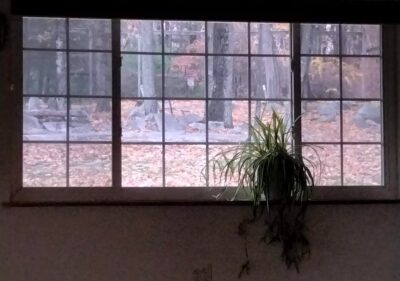
Windows can remind us of the beauty in life.
There is a difference between cheaper and more expensive double or triple-pane windows. Our vendor puts a blow-torch on one side then asks us to feel the temperature on the other side. Of course we upgrade windows to those that insulate better, which includes a specialized gas between the two panes. There are various standards to understand before you upgrade windows, which we explain below.
However, I also list cheaper options below that I also have used to help insulate my home.
Your Choices
| Upgrade Windows – Action Items and Links | Cost | Notes |
| Purchase New Windows | $,$$$ to $$,$$$ | Most expensive option, but options can save on winter heating and summer cooling. |
| Improve Insulation for Existing Windows | $$ | A few options can reduce winter cold and drafts and/or insulate from summer heat. |
| Use External Shading: Awnings, Trellises, Trees, or Overhangs | $$$ | Select external shading can block heat in summer and allow sun in winter |
| Parent Link: Ways to Save Energy | $ to $$$ | Other home energy efficiency techniques can cost less and reduce energy costs. |
Purchase New Windows
The best windows consist of 2-3 panes with an insulating gas (e.g., argon or krypton) between the panes. A U-factor is the inverse of insulation’s R-factor; lower U-factor values are better since they prevent heat from escaping the interior of the house in colder climates (Holladay, 2017).
If you purchase windows, you should understand standards related to new windows. Solar radiation consists of incoming visible light and infrared heat radiation (Amann et al., 2012). Glazing of glass is useful to control the solar radiation entering or heat escaping through the window. Solar Heat Gain Coefficient (SHGC) indicates the amount of solar radiation that may enter the house, and is particularly important in warm climates. For example, SHGC=0.8 means that 80% of solar energy passes through (Amann et al., 2012). Neither SHGC nor U-factor should rate above 0.3 in hot climates where lower values are better (Amann et al., 2012). In northern climates, like Canada, windows are sold with higher SHGC values to take advantage of incoming heat (Holladay, 2017). East and west exposures are most susceptible to incoming sunlight and thus SHGC changes.
Solar heat (SHGC) reduction is achieved with low-E (low emissivity) window coatings or film. These coatings not only limit incoming solar radiation for warm climates, but also reflect internal heat back into the home in cold climates. Upgrade windows on the cheap by purchasing Low-E film for existing windows to reduce solar gain; the film should be installed facing inside to protect the coating. Alternatively, storm windows installed over existing single pane windows are a great investment that can pay for itself in just over 4 years in a cold climate like Chicago (Holladay, 2017). Never use two layers of glass with low-E coating, since heat may accumulate between the coatings and damage windows.
Other metrics (some optional) include (Amann et al., 2012)(Holladay, 2017):
- Air leakage (AL) indicating how much air leaks through the window per square foot.
- Visible light transmittance: the amount of visible light that shines through. Higher numbers (above 0.4) are better.
- Condensation resistance: Numbers range between 0-100, where high indicates high resistance to condensation.
Statistics should reflect the whole window, not just the window panes (Holladay, 2017). Wood, vinyl and fiberglass frames conduct less heat than cheaper aluminum, which performs poorly in cold climates (Amann et al., 2012).
Improve Insulation for Existing Windows
If you do not want to replace windows: Here are other ideas if you want to insulate your windows better for cheap (Harley, 2012)(Amann et al., 2012):
- Storm windows: to buttress single pane windows and reduce heat loss by 50%, add storm windows. (Discussed above.)
- Plastic wrap: Renters can use plastic shrink wrap to warm windows and prevent air leakage. A layer of plastic wrap is taped to the walls around the window and heated with a blow dryer to make plastic taut across the window for visibility and attractiveness.
- Drapes: Shades and drapes need to be tight-fitting to prevent cold drafts from entering on exposed sides.
- Insulating cellular shades: These are rated using R-values but must be opened and closed manually to see out windows.
- Rope caulk: This temporary sealing (a preformed soft clay string) is used to seal window edges before winter and may be stored in foil between seasons.
Use External Shading: Awnings, Trellises, Trees, or Overhangs
To keep home cool: external shading is more effective than internal shading. Consider adding awnings, porches, overhangs and even trellises and arbors, to prevent solar heat gain (Harley, 2012). Trees and bushes can also prevent sun from entering, but in a dry climate, may also be susceptible to fires. The best windows to protect include east and west windows where the sun spends mornings and afternoons heating. South windows in summer are less susceptible, since the sun is overhead (Amann et al., 2012). Northern windows are not susceptible to solar radiation in North America.
References
- Amann, Jennifer Thorne, Wilson, Alex, and Ackerly, Katie (2012) Consumer Guide to Home Energy Savings, 10th edition. New Society Publishers, Gabriola Island, BC Canada.
- Harley, Bruce (2012) Insulate and Weatherize for Energy Efficiency at Home. The Taunton Press, Newtown CT.
- Holladay, Martin (2017) Musings of an Energy Nerd: Toward an Energy Efficient Home, TheTaunton Press, Newton CT.